Thursday, July 3, 2014

SELLING INCOMPETENCE TO THE WORLD ... A NEW INITIATIVE : Nigeria signs $1.2m PR deal to improve image after Boko Haram kidnaps President seeks to change the 'narrative' surrounding efforts to find schoolgirls taken by Islamic militants, says This is Africa ... TheGuradianUK

Part of the
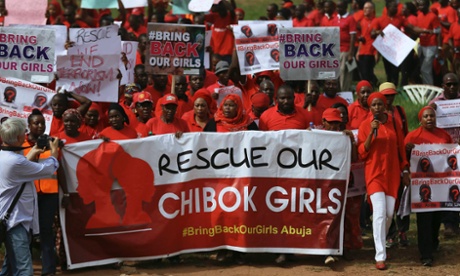
Protesters march to the presidential villa in Abuja to call for the release of kidnapped schoolgirls. Photograph: Afolabi Sotunde/Reuters

The Nigerian government has signed a contract worth more than $1.2 million with a Washington DC public relations firm to deal with the fallout from the Boko Haram kidnappings.
In a report in The Hill, documents show that the Nigerian president, Goodluck Jonathan, who is up for re-election in February, is seeking to counter the perception that he has not done enough to combat the Islamic extremists in his country who abducted more than 270 schoolgirls in Chibok in April.
According to a contract signed on 13 June, Jonathan’s government has hired Levick, a prominent PR and lobbying firm in Washington DC, to engage in an effort to change the “the international and local media narrative” surrounding Nigeria’s “efforts to find and safely return the girls abducted by the terrorist organisation Boko Haram".
The firm said the work for Nigeria will be more than just PR and will be part of an effort to create 'real change' in the country
The firm said the work for Nigeria will be more than just PR and will be part of an effort to create “real change” in the country. That change seems to constitute “public diplomacy and engaging outside experts to enact real changes”.
The firm will also be “assisting the government’s efforts to mobilise international support in fighting Boko Haram as part of the greater war on terror.”
An op-ed article written by Jonathan appeared in The Washington Post last week, in which he reiterated that Nigerian security services "will not stop until the girls are returned home and the thugs who took them are brought to justice".
Levick will be paid $75,000 per month for its work, in addition to the extra costs of advertisements, video production and website development, and is working for the government through a state-owned media agency. All in all, with additional expenses, the monthly retainer is brought to a total of $100,000.

Wednesday, July 2, 2014

SIGNS OF THE TIMES ... WHERE ARE WE HEADED? : 4 women arrested for kidnapping girl and selling her for N650,000 (PICTURED) ... NigerianEye


The police in Lagos have arrested four women after they allegedly kidnapped a 9-year-old girl and sold her off.
Fausat Ogidan, Abibat Oresanya, Bola Obajuruwa and Idiyat Abass were arrested over the deal which saw the child, identified simply as Blessing, being sold for N650,000
The women were arrested last month after the police received information as regards their illict trade.
Nigerian Eye reports:
The state Commissioner of Police, Umar Manko, had directed the command’s Special Anti-Robbery Squad, led by SP Abba Kyari, to go after the child sellers’ syndicate.
Ogidan, who was with the nine-year-old girl, and collected the sum on behalf of others, was arrested in the Gbagada area of Lagos.
Our correspondent gathered that the 51-year-old woman, who is married with four children, had arranged to sell the girl and on that Sunday.
Further investigations by our correspondent revealed that the girl was given to Ogidan by Obajuruwa, commonly known as Iya Alaje, who lives in the Suberu Street, Alakuko area of Lagos.
Iya Alaje also confessed that she had told Ogidan to sell the girl for N350,000 before she was caught.
She said, “I used to sell herbs in the Agege Market. I told Fausat (Ogidan) to sell the girl forN350,000, but Fausat added N300,000 as her own profit. The girl was sold to me by Idiyat (Abass) and her elder sister, Abibat.
“I bought her from them for N130,000. They said they were going to give the money to the girl’s mother who wanted to get rid of her because of poverty.”
Obajuruwa, when arrested, had led the police to Abass and Oresanya, who got the girl from her parents and connived to sell her.
Our correspondent further learnt that Abass, a 48-year-old woman, who was living in the Salau Dogo Street, Ibafo area of Ogun State, had obtained the girl from her mother, who the police said was still at large.
It was gathered that Oresanya claimed that Blessing’s mother had wanted to dispose of her and use the money obtained to take care of her other children.
However, during interrogation, Blessing, who said her real name was Yetunde, told the police that she was kidnapped from their residence in Ibadan.
When our correspondent visited Obajuruwa’s residence in Alakuko, her octogenarian mother said she had yet to find out what the police arrested her daughter for.
She said, “I just heard that policemen from Agege Police Division had come to take her away. I don’t know why she is being detained by them. I have yet to know her offence.”
Another relative, who identified herself simply as Funmi, claimed that Obajuruwa gave out Blessing, who was her grandchild, to a customer to assist in home chores.
She said,“There are about seven to eight children in this house. They are all Iya Alaje’s grandchildren. So, it happened that when one of her customers put to bed recently. She pleaded with mama to give her someone to assist her. Iya Alaje took Blessing, her seven-year-old granddaughter, to be staying with her. The second day, Blessing ran away from that house, and told the people who saw her that she had been kidnapped by the customer.
“That was why the police arrested mama and the customer, saying they kidnapped the girl.”
Our correspondent learnt that investigations were ongoing at the SARS on the matter.
The LagosState Police spokesperson, Ngozi Braide, promised to get back to our correspondent, but had yet to do so as of the time of going to the press.

FOR THE RECORDS ... A MESSAGE CLEAR AND INSPIRING : Okonjo-Iweala: FG Has Adopted Three-Pronged Approach to Stop Boko Haram ... ThisDayLive

Ngozi-Okonjo-Iweala-0207.jpg-Ngozi-Okonjo-Iweala-0207.jpg
Minister of Finance, Dr. Ngozi Okonjo-Iweala
Says insurgency will impact Nigeria’s GDP
•Soyinka: Sect’s carnage makes Nigeria’s break-up unlikely
By Obinna Chima with agency report

The Coordinating Minister for the Economy and Minister of Finance, Dr. Ngozi Okonjo-Iweala, has said that the federal government has adopted a three-pronged approach to ensure the safety and security of lives and property particularly in the North-east states where Boko Haram attacks have been prevalent.
Making this known yesterday in London when she briefed the British parliament on the Safe Schools Initiative, the minister said: “We are taking a three-pronged approach to dealing with the various dimensions of crisis, and this includes security, political and economic solutions.
“On the security front, our military men and women are confronting an unprecedented challenge that they were not really trained to confront and so we thank them for their courage and bravery. The President, Commander-in-Chief of the Armed Forces, has increased the number of troops that are in the North-east from 15,000 to 20,000.
“Regional cooperation on security has gotten better following a decision by neighbouring countries: Chad, Cameroun, Benin, and Niger, to each contribute a battalion of soldiers, to fight Boko Haram alongside Nigeria.
“President Goodluck Ebele Jonathan has accepted offers from the international community for more surveillance, aircraft cover, and equipment that enhances our ability to locate, fight and root out insurgents.”
These efforts, she assured the UK parliament, were beginning to make a difference, intimating them that Nigeria’s security forces busted a Boko Haram intelligence unit only two days ago.
“More of these counter-insurgency actions will be forthcoming. We are prepared to do whatever is necessary today, tomorrow and in the future to secure the country,” she added.
“On the political front, we are working with state governments, traditional and religious leaders within the most affected regions of the country, to encourage dialogue with the sect.
“The president set up a Dialogue Committee that is working behind the scenes and also a fact finding committee on the Chibok girls in particular.
“And finally on the economic front, given some linkages between the insurgency and high youth unemployment, we are trying various schemes to assist the youth in the region where possible.
“Using monies from our Subsidy Reinvestment Programme (SURE-P), we are implementing a Community Services Scheme that engages the youth in public works (we have so far recruited 11,500 youth into this programme – 4000 in Borno, 3500 in Adamawa and 4000 in Yobe State).
“We also have YouWin, which is supporting hundreds of young entrepreneurs with grants so they can start up a business or expand existing ones to create jobs for their fellow youth.
“Over the longer term, the government will vigorously pursue economic empowerment in the region through a Presidential Initiative for the North East (PINE) which is currently being developed,” the minister said.
She, however, told the British legislators that the president had instructed her to work with the international community, led by former British Prime Minister and UN Special Envoy for Global Education, Gordon Brown, and the Nigerian business community, led by the Chairman of the Dangote Group, Alhaji Aliko Dangote, and President of the Newspaper Proprietors Association of Nigeria (NPAN) and Chairman/Editor-in-Chief of THISDAY Newspapers, Mr. Nduka Obaigbena, in an initiative to make our schools safer.
“Every child is special, every child precious, every child unique. While we will never give up on the effort to locate the Chibok girls, we must also assure parents, pupils and teachers that schools are safe. Children and teachers must be again free to go to school unharmed and unafraid.
“So the Safe Schools Initiative is designed as a nationwide intervention programmes that will prioritise schools in states under emergency rule like Borno, Adamawa, and Yobe.
“To this effect, the Nigerian private sector has set aside US$10 million for this initiative and the Nigerian government has immediately matched that with another US$10 million.
“We are aiming for a fund of US$100 million and we have received indications of support from the World Bank, the African Development Bank, DFID, and the Norwegian and German Governments towards the initiative,” she stated.
Okonjo-Iweala stressed that schools must never be instruments of war, nor battlefields for terror campaigns, noting: “While we do not aim to turn our schools into fortresses, the Safe Schools Initiative will rely on needs assessments to deploy measures that will either upgrade existing security systems in schools or put in place new systems where they currently do not exist.
“These measures could range from the basic, such as perimeter fences, toilet facilities for girls, use of fire retardant materials in reconstructing schools, housing for teachers, community policing and school guards, to more sophisticated measures like alarm systems, communication equipment, and solar power panels to ensure schools are well lit,
"Whatever needs to be done to make all our schools safer and more secure we will consider. We will work with state governors, community leaders, teachers and parents to achieve the objectives of this initiative.”
She thanked the former British prime minister for his support in setting up the Safe Schools Initiative, and for his leadership of the international community on education for children, and indeed his efforts to get all of Nigeria’s 10.6 million “out of school” children, into schools.
She informed the parliament that the Safe Schools Initiative is just one of a three-part effort the federal government recently launched to deal with the crisis in the short term.
The other two, she said, are the Emergency Relief Initiative that will step up support by our National Emergency Management Agency (NEMA) to over 3 million displaced persons and communities through the provision of emergency accommodation, food, basic healthcare and other relief items as needed; and the Reconstruction and Rehabilitation Initiative, that will help rebuild public infrastructure that have been destroyed by the insurgents.
Members of parliament who listened to her speech included Brown; Rt. Hon. Harriet Harman MP, Deputy Leader of the Labour Party; Rt. Hon. Sir Malcolm Bruce MP, Chair of the International Development Committee; Rt. Hon. Justine Greening MP, Secretary of State for International Development; Alison McGovern MP, Shadow International Development Minister; and Meg Hillier MP, Chair of the All Party Parliamentary Group on Nigeria.
Others present were Baroness Glenys Kinnock, former Foreign Office Minister responsible for Africa; Baroness Sue Nye, former Head of Government Relations to UK Prime Minister Brown; Lord Jim Knight, former Education Minister; Lord Paul Boateng, former Chief Secretary to the Treasury and former High Commissioner to South Africa; David Bull, Executive Director, UNICEF UK; and Rt. Hon. Andrew Mitchell MP, former UK International Development Secretary.
Also, Glyn Davies MP, Phil Wilson MP, Sharon Hodgson MP, Dianne Abbott MP, Chi Onwurah MP, Lindsay Roy MP, Jim Sheridan MP, Lord Murray Elder, Ann McKechin MP, Valerie Vaz MP, Anne McGuire MP, Barbara Keeley MP, John Randall MP, Lynn Brown MP, Sandra Osborne MP and Lord Ian Blair, former Metropolitan Police Commissioner, were at the parliament during the minister’s presentation.

Insurgency to Impact Nigeria’s GDP
Similarly, the minister on Tuesday revealed that the Boko Haram insurgency will slow down Nigeria’s economy again this year, knocking half a percentage point off growth like last year, adding that her 6.75 per cent 2014 growth forecast took this into account.
Ngozi Okonjo-Iweala told Reuters that while the violence in the North-east might put off some potential foreign investors, those who are in Nigeria for the long-term seem to be holding their nerve, just like portfolio investors in its government debt.
“We are expecting about 6.75 (per cent growth in 2014) and we have accounted for the impact of the insurgency which we think will take half a percentage point off GDP growth,” she said in an interview during a visit to Berlin, Germany.
Nigeria overtook South Africa as the continent's biggest economy this year, following a rebasing calculation that almost doubled its gross domestic product.
The economy grew about 6.4 per cent last year, the minister said, with the Islamist rebels having most economic impact on agriculture in the North-east.
The economist and former World Bank managing director said her talks with German Finance Minister Wolfgang Schaeuble emphasised “our strong fundamentals despite the challenges that we face”.
She sought his support for the creation of a new Nigerian development bank to improve financing to small and medium-sized private enterprises which could become an “engine for growth” as the country seeks to diversify its economy away from oil.
Rebasing the country’s GDP had revealed hidden strength in sectors such as services and telecoms, which had “gone to 0.7 per cent of GDP to 7 per cent” and was seeing strong growth, said the minister.
She said the creation of a secondary mortgage market could help kick off growth in housing, another sector that she hoped could “help to make up for some of the lost growth”.
The minister cited government bonds yields of 4 to 5 per cent as evidence that financial investors were not panicking: “The prices are quite reasonable which is an objective assessment that investors may be looking at the long-term underlying fundamentals of the economy, which are strong.”
However, some potential foreign direct investment might be affected negatively by the Islamist insurgency, she said, but existing investors - especially those from emerging powers such as South Africa, China and Brazil - were proving resilient.
“Part of our turbulence may also be linked to the upcoming election (in 2015),” the minister said. “Whenever we have elections there is always some increase in violence and disturbance.”
Boosting the regional economy is part of President Goodluck Jonathan’s response alongside counter-insurgency efforts and attempts at dialogue with Boko Haram, which was hampered by the fact that “they have not articulated any political demands”.

Soyinka: Nigeria’s Break-up Unlikely

Meanwhile, Soyinka, speaking to Reuters at his home in Abeokuta, Ogun State, has said Nigeria is suffering a greater carnage at the hands of Islamist group Boko Haram than it did during a secessionist civil war, yet this has ironically made the country's break-up less likely.
Soyinka said the horrors inflicted by the terrorists had shown Nigerians across the mostly Muslim north and Christian south that sticking together might be the only way to avoid even greater sectarian slaughter.
The bloodshed was now worse than during the 1967-70 Biafra war when a secessionist attempt by the eastern Igbo people nearly tore Nigeria up into ethnic regions, he added.
“We have never been confronted with butchery on this scale, even during the civil war,” Soyinka said in his front room, surrounded by traditional wooden sculptures of Yoruba deities on Tuesday.
“There were atrocities (during Biafra) but we never had such a near predictable level of carnage and this is what is horrifying,” said the writer, who was imprisoned for two years in solitary confinement by the military regime during the war on charges of aiding the Biafrans.
Soyinka, a playwright and one of Africa's leading intellectuals who still wears his distinctive white Afro hairstyle, turns 80 in two weeks. He was awarded the Nobel Prize for Literature in 1986, the first African writer to receive it.
A million people died during the Biafra war, though mostly through starvation and illness, rather than violence.
Boko Haram's five-year-old struggle to carve out an Islamic state from its bases in the remote northeast has become increasingly bloody, with near daily attacks killing many thousands.
The conflict's growing intensity has led Nigerian commentators to predict it may split the country, 100 years after British colonial rulers cobbled Nigeria together from their northern and southern protectorates.
“I think ironically it's less likely now,” Soyinka said. “For the first time, a sense of belonging is predominating. It's either we stick together now or we break up, and we know it would not be in a pleasant way.”
Several regional movements have launched low-level independence campaigns that get little national attention. But Soyinka said fewer people were shrugging off Boko Haram’s menace.
“It’s almost unthinkable to say: ‘Well, let's leave them to their devices.’ Very few people are thinking that way.”
Attacks spreading southwards, including three bombings in the capital since April, showed it is not just a northern problem.
“The (Boko Haram) forces that would like to see this nation break up are the very forces which will not be satisfied having their enclave,” he said. “(We) are confronted with an enemy that will never be satisfied with the space it has.”
Soyinka blamed successive governments for allowing religious fanaticism to undermine Nigeria's broadly secular constitution, starting with former President Olusegun Obasanjo allowing some states to declare Sharia law in the early 2000s.
“When the spectre of Sharia first came up, for political reasons, this was allowed to hold, instead of the president defending the constitution,” he said.
Soyinka sees both Christianity and Islam as foreign impositions.
“We cannot ignore the negative impact which both have had on African society,” he told Reuters. “They are imperialist forces: intervening, arrogant. Modern Africa has been distorted.”
He added that while the leadership of Boko Haram needed to be “decapitated completely”, little had been done to present an alternative ideological vision to their “deluded” followers, driven largely by economic destitution and despair.
THE ARROGANCE OF A PRIVILEDGED NIGERIAN EX POLICE AIG ... Yeye de smell : Uproar at Confab as former Police AIG threatens to arrest delegate ... PremiumTimes

Conference 11
The Edo delegate challenged the census figures of Northern Nigeria.
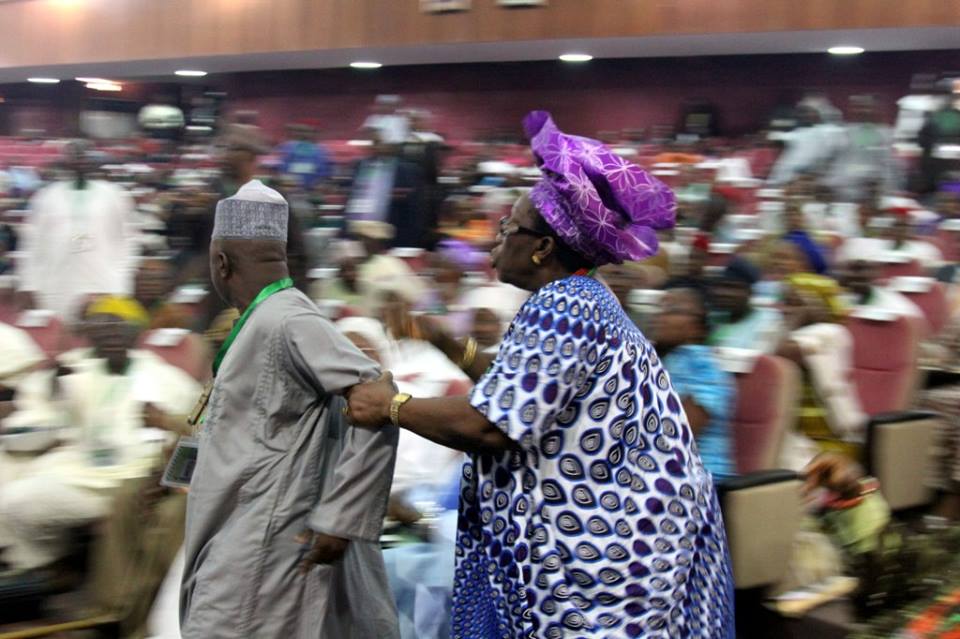
A mild uproar broke out at the National Conference on Wednesday following a threat by former Assistant Inspector-General of Police, AIG, Ibrahim Ahmed, to arrest a delegate from Edo State, Chris Agbonwanegbe, for challenging the census figure of Northern Nigeria.
Mr. Agbonwanegbe, who was contributing to the report of the Conference Committee on Political Restructuring and Forms of Government, had challenged the census figures bandied by states in the North.
He called on delegates to address the injustice that led to the creation of more states and local governments in the North as against what is obtainable in the South.
Mr. Agbonwanegbe made a specific reference to the disparity in the number of local governments in Kano and Lagos states.
He argued that while Lagos has the highest number of people in Nigeria, it has only 20 local government areas, while Kano with a lower population has 44.
As the Edo delegate was addressing the Conference, his Northern counterparts shouted and rebuked him for daring to challenge the population of Kano.
But Mr. Agbonwanegbe stood his ground and insisted that sustainable development would continue to elude the country if steps are not taken to conduct reliable census to gather data for national planning and development.
He, however, lamented that Nigeria does not have the capacity to conduct a free and credible census, and suggested that the United Nations, UN, be invited to conduct census for the country.
He noted that if the UN is allowed to conduct a credible census, the country would have correct figures that would finally put the long years of population disparity to rest.
Mr. Agbonwanegbe said, “I did my National Youth Service Corps, NYSC, programme in the North. So, I know what I saw during my service years. I can authoritatively tell you that there is injustice in this country.
“How can a state like Katsina or Kano have more local government areas than Lagos which has the highest population? It is obvious that there is injustice and this should be addressed.
“From previous censuses we have had, it is obvious that Nigeria cannot conduct a credible census. We need to invite the United Nations to help us in conducting a census that will be accepted by everyone and finally put the argument about the region with the highest number to a rest.”
Mr. Agbonwanegbe’s submission did not go down well with many delegates from the North who almost threw caution to the wind in a bid to stop him from speaking further on the matter.
While the Northern delegates screamed and raised a point of order to stop the Edo delegate from continuing to speak, Conference Chairman, Idris Kutigi, ignored them.
But the former AIG, Mr. Ahmed who could not hold back his anger flouted the rule of the house by screaming, “Arrest him! Arrest him now!”
Mr. Ahmed remained on his feet shouting, thereby polarizing the Conference along Northern and Southern lines.
While the delegates raved and ranted, another Kano delegate, Junaid Mohammed, went and met with Mr. Agbonwanegbe and two of them walked out of the chamber, holding hands and talking.
As the duo were leaving the chamber, some Northern delegates castigated Mr. Kutigi for refusing to stop the Edo delegate from challenging the population of Kano State.
Not long after, former governor of Ogun State, Segun Osoba, re-echoed the position of Mr. Agbonwanegbe and called for the reversal of the injustice he said characterized the number of local government councils in some parts of the country.
Mr. Osoba drew attention to Lagos State, which he said contributes more than 80 per cent to the nation’s Value Added Tax, VAT, yet does not have the required number of local government areas unlike states in the North.
“The era of trying to manipulate census figure is over. With the help of Google, we can now get the number of people in a particular area. We can use that to conduct our census. I do not subscribe to the fact that the United Nations should conduct our census for us.”

SIGNS OF THE TIMES : ‘I belong to Ogboni confraternity and CAN’ – Lagos Pastor confesses .... A MUST READ ... SunNews

“I am not ashamed to confess my mem­bership of the fraternity. I’m proud to be Og­boni member. In actual fact, being an Ogboni leader has made me not only a good disciple of Jesus Christ, but it has also gone a long way to make me a better citizen,”
‘I belong to Ogboni confraternity and CAN’ – Lagos Pastor confesses

A popular pastor, Solomon Oladimeji, who is founder of Cherubim and Seraphim Church, Orisun-Ayo, with branches at Alapere, Ketu, and Odogunyan in Ikorodu area of Lagos, has confessed to being a member of the Ogboni confraternity.
Oladimeji, 65, says that there is no stigma that should be associated with the cult which is rumoured to be a gathering of evil doers by most Nigerians. 
In this interview with SUN, Oladimeji, who is also a member of the Christian Association of Nigeria talks about blood sacrifices, charms and his views on the misconceptions of practising Christians in Nigeria.
Excerpts:
When did you become a member of the Ogboni, and what were the cir­cumstances that prompted you to be a member?
Although, my journey as shepherd for Je­sus Christ’s flock is over 40 years, I became a member of theOgboni society over 20 years ago. Initially, I was initiated into the Aborigi­ne Ogboni fraternity, that is the one they call Ogboni Ibile, but later I joined Saala Ogboni fraternity, and since I made that decision, I have no regret.
As a member of Ogboni fraternity, my life is having a meaning. I have prospered. My coast has been enlarged. Members of my congregation are increasing everyday. I also thank God that due to my diligence as a committed member, I have been able to rise to the enviable position of Oluwo within the Ogboni fraternity.
Are your members, that is mem­bers of your church aware that you belong to Ogboni fraternity?
What is there to be hidden? I am not ashamed of my association with Ogboni So­ciety, and I don’t hide it from members of my church. They all know that I’m a leader in the Ogboni group. When you even come to my house, I openly display my regalia as Ogboni chief. Let me quickly tell you this, by making my members know that I’m Ogboni mem­ber, it makes me popular among them. They describe me as an open and honest person. For that, many of them have been voluntar­ily coming to me pleading to be initiated as a member of Ogboni fraternity.
Some people would think that you use charms on them?
Why should I use charm on them or to charm them as some people will say? God forbid. I’m a child of light; darkness or any­thing evil has no place in my life or church. Your member will like you, when they know that the power you are using to solve their problems is power from Jesus Christ, my Lord and Saviour. I have never committed evil in my life and I will never do so till the day my Lord calls me home.
Are you saying that charm doesn’t exist?
No. I’m not saying so. Charms do exist, but it depends on how you use it. I used herbs and leaves combined with other items to pre­pare soap, anointing oil for members and oth­er people that are having spiritual problems.
It is unfortunate that today a lot of Chris­tians are suffering out of ignorance. You see some saying it is what my pastor or what my prophet tells me I believe. I will never use any soap, cream, oil by just any minister of God, but only if those members know what those pastors are doing.
Some of these pastors and prophets come to people like me to acquire power to per­form miracle and wonders. Some of them are even Ogboni members like me. But they are hypocrites. I will never deny somebody who is my benefactor, and that is why you see me wearing and displaying beads and other items being used by Ogboni fraternity. To me, what matters again is saving life, and it doesn’t matter where you get saved whether it is in the house of babalawo or any juju priest. We are all calling on the name of the same God.
In my neighbourhood, both at Alapere and Odogunyan, many residents know me both as a cleric andOgboni leader. In fact, Baale of Odogunyan, that is the community leader, knows me as the Oluwo ofSaala Ogboni. I’m highly respected in the community. I joined the Ogboni fraternity because I like their ways of life. They are decent people. Contra­ry to misconception some people have about Ogboni, that we are evil people. Far from it, rather I will say that Ogboni members are not only children of Light, but we are also mes­sengers of the Most High God because, we don’t kill but only save lives.
But some people believe that Og­boni is evil, and that it is an evil asso­ciation condemned by the Bible.
Those who say so are ignorant. They have been brainwashed by our colonial masters. But thank God, we are now in a different era, and we can all be reading the Bible without relying or depending on what the imperialist swould want us to believe in order to suit their own purpose. Some will tell you that Ogboniis evil because they use juju, they still carry out sacrifices of various forms by shedding blood of animals, and birds. Some even out of ignorance say we eat human flesh. Rubbish. May Almighty God forgive our traducers.
If you are talking about sacrifice, where did the Bible condemn sacrifice? Let our accusers point it out either in the old or the New Testament. Throughout my years at the seminary and the Bible school, I never come across such.
Then the sacrifice you are talking about, on several occasion especially in the Old Testa­ment, sacrifices were carried out to atone for the sins of the Israelites.
It was also often carried out when the chil­dren of Israel were looking for one favour or another.
But coming down to the New Testament, don’t mind those confusionists who say that Jesus Christ, my own Lord and Saviour con­demns sacrifice, what a big lie. If you can still remember when Jesus Christ himself was born the day His parents Joseph and Mary were taking Him to the Synagogue, Joseph has to sacrifice doves, and pigeon. He took the birds to the church. You can read in the book of Matthew and Luke.
So, if the parents of Jesus, my Master, the Author and Finisher of my Faith were in­volved in sacrifice, why would I say I want to distance myself from such?
Again, they accused us pastors of asking some people that have problems to go and bathe in a running stream, what is wrong with that, did such not happen in the Bible? Have we forgotten the story of Naman, the Syrian Army General who had leprosy and was look­ing for a cure, how Prophet Elisha asked him to go bathe inside River Jordan, and Naman was healed after complying with the prophet’s instruction, and this is why I said some people are dying due to ignorance.
Sacrifice is biblically ordained. I sacrificed animals and birds to offer prayers to cure and heal people of their ailments.
When I pray for you and it is revealed to me that I should kill duck, cow or even goat to offer prayers for you, I will tell you to make available such animals for sacrifice, and the moment we do that, you receive your healing.
When I kill fowl, goat, duck or even cow for sacrifice to heal somebody, I have not in any way transgressed. I’m only doing the will of Jesus Christ, who is my personal Lord and Saviour. Whatever is outside the Bible, you will never see me doing it.
Even in the book of Revelation, the use of leaves and herbs was recommended for heal­ing. And for those who describe Ogboni fra­ternity as a cult, this is wrong. Ogboni is a society. We are transparent and honest people. Ogboni abhors evil. We are organized and dis­ciplined. A cult is a group of people involved in secrecy, we are open to scrutiny. Let those who out of hearsay say evil about Ogboni be bold and come to our meeting and see wheth­er it is true that we drink blood.
All those pastors saying rubbish about Og­boni are doing so to attract membership.

You say you sacrifice animals, if that is what is needed for someone’s prayers to be answered, but the Bible says Jesus has done that by His death, are you not going against the Bible?
Far from it! Whatever I do as Ogboni Pastor is biblically ordained and inspired. If you read your New Testament very well, Apostle Paul who is regarded as one of the most dynamic evangelists of his era says that without shedding blood, that there is no redemption. Am I the one that put that in the Bible? Even when Jesus Christ was about to be dedicated, His parents, Joseph and Mary took pigeons and doves to the church which were slaughtered as a sacrifice.
You also read in several other places both in the Old and New Testament where blood sacrifice took place. You remember the case of Cain and Abel. I even read Bible before I carry out this killing of animals as sacrifice in order to save souls.

Tuesday, July 1, 2014

THE JONATHAN GOSPEL OF STEALING AND CORRUPTION TAKES A HUMAN FACE : The non-fight against corruption ... A Guardian Editorial Opinion.

Adoke FOR those who say Nigeria is a country where wonders shall never end, a new example is the dropping of the nine-count charge preferred against Mohammed Abacha, son of the late head of state, Sani Abacha. The reasons for dropping those charges are unacceptable, even if they seem expedient, as they mock Nigeria and all her pretences to fighting corruption. 
  Mohammed Abacha had, inter alia, been charged with unlawfully receiving about N446.3 billion allegedly stolen from government’s coffers between 1995 and 1998. No thanks to the power of nolle prosequi conferred on the Attorney General of the Federation by the 1999 Constitution; he has now exercised that power to save Abacha in clearly undeserving, unusual, unpatriotic, and ill-suited circumstances. The withdrawal of those charges is as bizarre as the reason proffered for doing so. Nigeria has thus been reduced by certain desperation to a state of anomie, where indecency, impunity and absurdity reign supreme.
   Defending the withdrawal of the charges, the Attorney General of the federation, Mohammed Adoke, said through his press secretary that the withdrawal would facilitate the recovery of $380 million from the Luxembourg proceedings and another $550 million from forfeiture proceedings by the US Department of Justice. Besides, he said the Abacha family had pledged to cooperate fully in the recovery proceedings; government had achieved the key objective of depriving the criminal of the proceeds of crime; and that in any event, the case has lingered for over 16 years.
   These reasons, given after public outcry on the withdrawal, are merely face-saving and self-serving. It is wrong to sacrifice the justice of one case on the altar of another. The state should not woo, or be seen to be patronising the family of the accused in order to seek their cooperation to recover public fund. And the issue of punishment is crucial, as a deterrent factor to would-be-looters of state treasury and their cohorts.
   To give the facade of a civilised nation, it is fashionable for the country to adopt laws which make other nations function and rise above medieval values, norms and precepts. However, laws designed to produce certain consequences, time-tested to ensure good governance, good behaviour, and the creation of a just, peaceful and orderly society, seem to work the opposite in Nigeria. The laws that serve public purposes and the ends of justice in the countries from where they were inherited are twisted to work against public interest. Nolle prosequi as a constitutional prescription should serve no less than public interest, the best end of justice in its objective and untainted form. This is explicitly stated in Section 174(3) of the 1999 Constitution, which admonishes that “in exercising his powers under this section, the Attorney General of the Federation shall have regard to the public interest, the interest of justice and the need to prevent abuse of legal process.” This is not different from what obtains in other civilised democracies; what is different is the attitude and character of those endowed with such powers. Here, Nigerians have seen the worst of what it could be used for – a means of oiling the machinery of evil, fraud, corruption, brigandage, lawlessness and a bargaining power for electoral success. While other nations are using state powers to force their leaders to account for the misdeed of the past, in particular corruption in office, as it happened in Israel in the case of Ehud Olmert, Egypt in the case of Hosni Mubarak and Thailand in the case of former prime minister, Thaksin Shinawatra, Nigeria on her part deploys state powers to help criminals of repute get away with horrendous act against the country and humanity generally at the altar of political expediency. This seems to be the logic that culminated in the unconscionable withdrawal of charges by the Federal Attorney General and the discharge of Mohammed Abacha by the court. Nigeria’s public officials should regard the powers given to them by the constitution of Nigeria as sacrosanct and for that reason show utmost sense of responsibility in the way they are deployed. They should resist the temptation to sacrifice common good for self-preservation or personal good or objective. Intense individualism should give way to statesmanship and public good. In all of these, Nigerians who are traumatised by lack in every area, who contend with decrepit infrastructure and groan under the yoke of poverty are the ultimate losers. Their craving for a nation where peace and justice reign has become a mirage. The development is a sad commentary on due process of law, administration of criminal justice and the fight against corruption in Nigeria in addition to being the shame of a nation. The Minister of Finance, Ngozi Okonjo-Iweala, should never have lent her weight to such a melodrama and craftiness that would readily serve as an apostle of such an infamy. Government’s explanation flies in the face of the Supreme Court’s ruling dismissing Abacha’s no case submission, meaning that a prima facie case had been established against him by the prosecution, nay the state, requiring that he defended himself. The withdrawal of that case in the face of the Supreme Court’s ruling, therefore, is no more than a soft landing for Abacha, in furtherance of a growing tendency of this government to provide safe haven for criminals and enemies of state as part of countdown to the 2015 elections.
    It is also a pity that well-meaning Nigerians merely watch in bewilderment as this malaise gather momentum, forgetting that the price they pay for this is good governance. What times like this require are virile civil society organisations, a dynamic citizenry, a vocal populace and a Nigerian Bar Association that is up and doing, insulated from partisan politics and bold enough to decry audacious exercise of powers.  Nigerians cannot afford to be guilty of conspiracy of silence, mute indifference and cold complicity which their silence would suggest should they continue to ignore these humongous travesties of justice without a modicum of decorous protest. But Nigerians may be silent, they are not hoodwinked or persuaded by fairy tales or the shenanigan of a government determined to remain in power regardless of the damage this may occasion to the soul of the nation and the psyche of its people. Let every corrupt leader or person who enjoys government’s protection today, however, know that the days of reckoning are inevitable, after all.

CASTING SPELLS FOR 2015 ... WHEN RICE FAILS TO DO THE TRICK, FUEL MAY COME TO THE RESCUE : Jonathan’s re-election: Ex-militants vow to cut off fuel supply to North if… VanguardNews

http://dvsl3w2q45hb8.cloudfront.net/wp-content/uploads/2010/08/EX-Militants.jpg


ORON—Repentant militant leaders in the Niger Delta have threatened to cut off the supply of petroleum products to Northern Nigeria, should the North oppose the re-election of President Goodluck Jonathan in 2015.
The ex-militants, at their meeting in Oron, Akwa Ibom State,  also threatened to ensure that the North did not benefit from crude oil proceeds generated from the Niger Delta region.
The ex-militants converged in Oron under the aegis of the Leadership, Peace and Cultural Development Initiative, where they assessed the handling of Niger Delta Development Commission, NDDC, projects by contractors.
President of the group, Mr. Reuben Wilson, said that their interest was to ensure that Jonathan returned to office in 2015, while  anybody opposed to the idea would be considered an enemy of the region.
He said: “We met in Oron to review developments in the country, particularly the interest of the Niger Delta people. You will agree that the Niger Delta is the main stay of the nation’s economy. You will also agree with me that the Niger Delta people are sustaining the economy at great inconveniences and pains to its people and the environment. This has been the only time that the region has had the privilege of producing a president for the country.
“It is unthinkable that the North will be plotting against our son, intimidating him with bomb blasts here and there and causing the untimely death of scores of innocent Nigerians, all because they want to take back power.
“We have always seen the need for us to live together as one indivisible country and that is what Mr. President believes in.”